
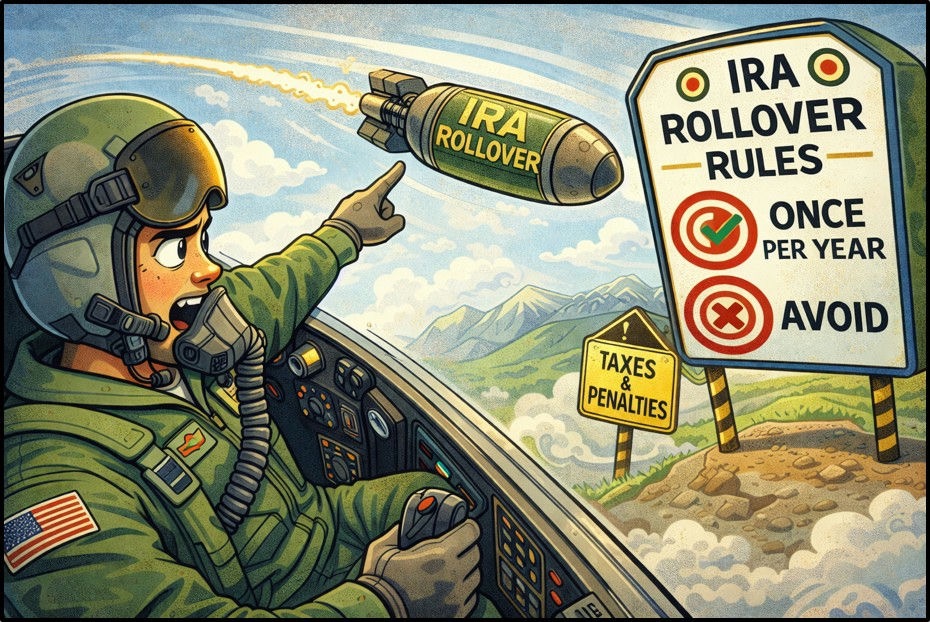
Why IRA Rollovers Matter — and How to Avoid a Costly Mistake
Many people choose to do an IRA rollover when they want to consolidate retirement accounts, change financial institutions, or move funds to an account with better investment options or lower fees. It’s a common step in keeping your retirement savings organized and working efficiently for you.
But when it comes to IRA rollovers, there’s one rule that often trips people up — the once-per-year IRA rollover rule.
At first glance, this rule sounds simple:
You can only do one IRA-to-IRA (or Roth IRA-to-Roth IRA) rollover in a 12-month period.
That’s it — one every 365 days.
But the details matter, and misunderstanding them can lead to unexpected taxes and penalties.
The Common Confusion
A lot of people wonder whether the rule applies to the number of distributions or the number of deposits — and that’s where the trouble begins.
Let’s break it down:
❌ Multiple distributions, one deposit — not allowed
If you take out money from your IRA more than once during the year, even if it’s from the same account, only one of those distributions can be rolled over.
Example:
Robin withdraws $2,000 from his IRA on December 1, and then another $30,000 on December 12. He plans to roll both amounts into a new IRA on December 20. Unfortunately for Robin, only one of those distributions is eligible for rollover. The other will be taxable, and if he tries to deposit it, he could face penalties for making an excess contribution.
✅ One distribution, multiple deposits — okay
Now flip the scenario. If you take out one distribution, you can split it and roll the money into multiple IRAs, even on different days — and it’s perfectly fine under the rule.
Example:
Ella takes a $90,000 distribution from her IRA on November 15. She rolls $75,000 into one IRA on November 20 and $15,000 into another IRA on November 25. Since she only received one distribution, both rollovers are allowed.
The Smarter (and Easier) Option: Direct Transfers
Here’s the truth — most people don’t need to deal with the 60-day rollover process at all.
A trustee-to-trustee transfer (also called a “direct transfer”) moves your IRA funds straight from one financial institution to another without you ever touching the money. That means:
It doesn’t count toward the once-per-year rollover rule.
You can do as many transfers as you want in a year.
You completely avoid the risk of taxes and penalties for getting the timing wrong.
Bottom Line
IRA rollovers are an important financial tool — they let you move your retirement savings where they’ll grow best. But they also come with fine print that’s easy to miss. Understanding the once-per-year rollover rule (and when to avoid it altogether) helps you protect your retirement savings from unnecessary taxes and penalties.
When in doubt, go with a direct transfer. It’s simpler, safer, and keeps your money working for your future — exactly where it belongs.
Fight’s On!
Winged Wealth Management and Financial Planning LLC (WWMFP) is a registered investment advisor offering advisory services in the State of Florida and in other jurisdictions where exempted. Registration does not imply a certain level of skill or training.
This communication is for informational purposes only and is not intended as tax, accounting or legal advice, as an offer or solicitation of an offer to buy or sell, or as an endorsement of any company, security, fund, or other securities or non-securities offering. This communication should not be relied upon as the sole factor in an investment making decision.
Past performance is no indication of future results. Investment in securities involves significant risk and has the potential for partial or complete loss of funds invested. It should not be assumed that any recommendations made will be profitable or equal the performance noted in this publication.
The information herein is provided “AS IS” and without warranties of any kind either express or implied. To the fullest extent permissible pursuant to applicable laws, Winged Wealth Management and Financial Planning (referred to as “WWMFP”) disclaims all warranties, express or implied, including, but not limited to, implied warranties of merchantability, non-infringement, and suitability for a particular purpose.
All opinions and estimates constitute WWMFP’s judgement as of the date of this communication and are subject to change without notice. WWMFP does not warrant that the information will be free from error. The information should not be relied upon for purposes of transacting securities or other investments. Your use of the information is at your sole risk. Under no circumstances shall WWMFP be liable for any direct, indirect, special or consequential damages that result from the use of, or the inability to use, the information provided herein, even if WWMFP or a WWMFP authorized representative has been advised of the possibility of such damages. Information contained herein should not be considered a solicitation to buy, an offer to sell, or a recommendation of any security in any jurisdiction where such offer, solicitation, or recommendation would be unlawful or unauthorized.