
Why Veterans—Especially Pilots—Should Embrace the VA Disability Process
For many veterans, filing for a VA disability rating sits somewhere between “I’ll get to it later” and “that’s not really for me.” There’s a quiet resistance to it—sometimes out of pride, sometimes out of discomfort, and often out of a belief that it’s somehow gaming the system.
It’s not.
In fact, for separating or retiring service members, going through the VA disability evaluation process is mandatory. The system is going to evaluate you, whether you lean into it or not. The real decision isn’t whether to participate—it’s whether you’re going to approach it honestly and intentionally, or rush through it and potentially leave meaningful benefits on the table.
And for pilots in particular, this conversation hits a little differently.
The Pilot Mentality: “Don’t Go DNIF”
If you’ve spent time in aviation, you already know the culture.
Aches and pains?
“Just part of the job.”
Something bothering you physically?
“Give it a day.”
There’s always that underlying pressure—spoken or unspoken—to avoid going DNIF (Duties Not Including Flying). Because going DNIF means stepping out of the cockpit, impacting the mission, and sometimes feeling like you’re letting the team down.
So what happens?
You push through.
You “walk it off.”
You rub some dirt on it and keep flying.
That mindset builds great operators. It does not build a great paper trail for your long-term health.
The Problem With Toughing It Out
What makes you effective in uniform can work against you later.
When it comes time to go through the VA disability process, the system isn’t evaluating how tough you were—it’s evaluating what impact your service had on your body over time.
If you spent years:
Not reporting issues
Minimizing symptoms
Avoiding medical documentation
Then you’re essentially asking the VA to connect dots that were never clearly recorded.
And that’s where many veterans unintentionally shortchange themselves.
This Isn’t About Gaming the System
There’s a persistent misconception that filing for VA disability—or being thorough in the process—is somehow taking advantage of the system.
It’s not.
The VA disability framework exists to:
Recognize service-connected wear and tear
Provide compensation for long-term impact
Support veterans as those conditions evolve over time
Being honest about your condition isn’t an exaggeration.
It’s not “working the system.”
It’s simply participating in the system the way it was designed to work.
Why the Rating Matters More Than You Think
A VA disability rating isn’t just a number—it’s a gateway to a range of benefits that can meaningfully impact your financial life and your family’s future.
That includes monthly, tax-free compensation, access to healthcare, and eligibility for additional federal and state-level programs. But beyond that, it creates something even more important: a documented record of your conditions.
Because here’s the reality—what feels manageable at 30 or 35 often doesn’t stay that way.
The Value of a 90% Rating (Especially in Virginia)
For veterans living in Virginia, even a 90% disability rating can provide a strong financial and support foundation.
The monthly compensation at that level is substantial and, importantly, tax-free. That alone can create breathing room in a financial plan—whether it’s offsetting living expenses, reducing reliance on earned income, or allowing for more flexibility in career decisions.
It also expands access to VA healthcare, often reducing or eliminating out-of-pocket costs for many services. For someone who has spent years pushing through physical strain, that access becomes increasingly valuable over time.
And then there are the family implications.
The Overlooked Benefit: Chapter 35
If a veteran is rated at a level that qualifies as Permanent & Total, their dependents may be eligible for Chapter 35 DEA benefits.
This is one of the most underutilized and under-discussed benefits available.
It provides education assistance for spouses and children, including monthly stipends that can be used for college, trade schools, and certification programs. Over time, this can represent tens of thousands of dollars in value, directly supporting your family’s future.
It’s not just about your rating—it’s about what that rating unlocks for the people around you.
The Importance of Being Up Front
When you go through your VA exams and documentation, there’s a natural tendency—especially among pilots and high-performers—to downplay things.
You might think:
“It’s not that bad.”
“I can still function.”
“Others have it worse.”
All of that may be true. But it’s not what the VA is measuring.
They’re looking at:
Frequency of symptoms
Severity
Impact on daily life
If you minimize those factors, your rating will reflect that. And once that rating is set, correcting it later can be a much steeper uphill climb.
Being up front doesn’t mean exaggerating—it means accurately describing reality, not the version of it you’ve learned to tolerate.
Think About Your Future Self
The version of you making this decision today is likely still capable, still pushing, still adapting.
But the VA process isn’t about just today—it’s about the next 10, 20, or 30 years.
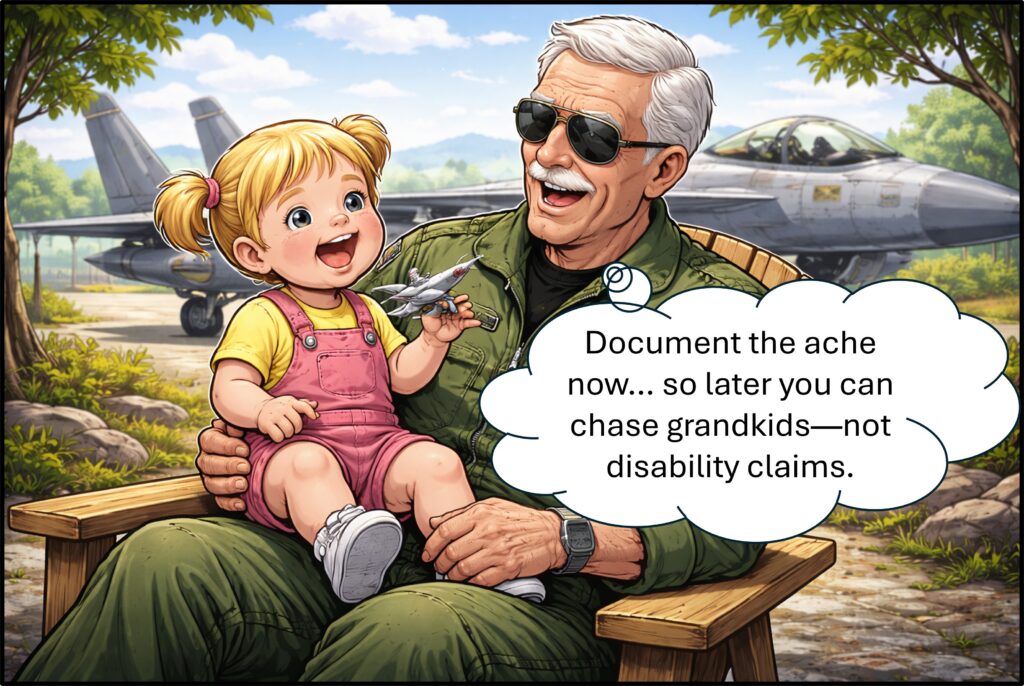
That knee that aches after long flights.
That back that tightens up after sitting in the cockpit.
That hearing that’s not quite what it used to be.
Those things tend to compound, not disappear.
And if they’re not documented now, connecting them back to your service later becomes significantly harder.
Embrace the Process
You don’t have to love the VA process. Most people don’t.
But it’s worth reframing how you think about it.
This isn’t:
A handout
A loophole
Or a system to game
It’s part of your transition.
It’s part of closing the loop on your service.
It’s part of taking care of your future.
And most importantly—it’s something you’ve already earned.
Final Thought
For years, you showed up, did the job, and pushed through whatever came your way—often without complaint.
But this is one area where that same mindset can cost you.
So don’t rush it. Don’t minimize it. And don’t treat it like an afterthought.
Go through the process. Be honest. Document everything.
Because the goal isn’t to get the highest rating possible.
The goal is to get the right rating, based on the reality of what your service required of you.
And that starts with telling the full story—even the parts you’ve been trained to ignore.
Fight’s On!
Winged Wealth Management and Financial Planning LLC (WWMFP) is a registered investment advisor offering advisory services in the State of Florida and in other jurisdictions where exempted. Registration does not imply a certain level of skill or training.
This communication is for informational purposes only and is not intended as tax, accounting or legal advice, as an offer or solicitation of an offer to buy or sell, or as an endorsement of any company, security, fund, or other securities or non-securities offering. This communication should not be relied upon as the sole factor in an investment making decision.
Past performance is no indication of future results. Investment in securities involves significant risk and has the potential for partial or complete loss of funds invested. It should not be assumed that any recommendations made will be profitable or equal the performance noted in this publication.
The information herein is provided “AS IS” and without warranties of any kind either express or implied. To the fullest extent permissible pursuant to applicable laws, Winged Wealth Management and Financial Planning (referred to as “WWMFP”) disclaims all warranties, express or implied, including, but not limited to, implied warranties of merchantability, non-infringement, and suitability for a particular purpose.
All opinions and estimates constitute WWMFP’s judgement as of the date of this communication and are subject to change without notice. WWMFP does not warrant that the information will be free from error. The information should not be relied upon for purposes of transacting securities or other investments. Your use of the information is at your sole risk. Under no circumstances shall WWMFP be liable for any direct, indirect, special or consequential damages that result from the use of, or the inability to use, the information provided herein, even if WWMFP or a WWMFP authorized representative has been advised of the possibility of such damages. Information contained herein should not be considered a solicitation to buy, an offer to sell, or a recommendation of any security in any jurisdiction where such offer, solicitation, or recommendation would be unlawful or unauthorized.